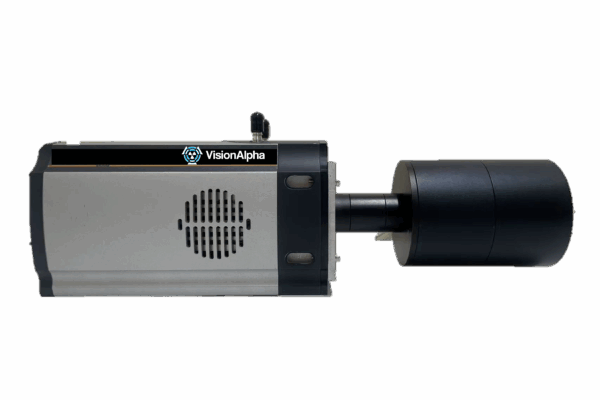
Long range imaging system for preciously locating alpha emitters down to 500Bq/cm2 from meters distance.
The VisionAlpha project, developed at the University of Bristol, introduces a breakthrough imaging system capable of detecting alpha-emitting contamination from a distance. Traditional alpha detectors require close contact due to the short range of alpha particles, making large-area surveys slow and hazardous. VisionAlpha overcomes this limitation by capturing the faint radioluminescence produced as alpha particles ionise air molecules, enabling non-contact mapping of contamination from metres away. This innovation offers a safer, faster, and more comprehensive approach to alpha contamination monitoring in nuclear facilities.
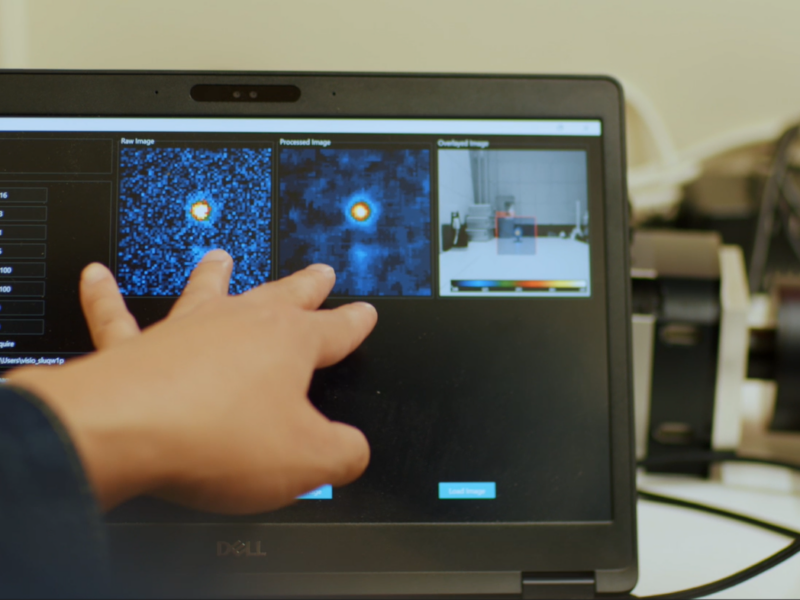
VisionAlpha employs a highly sensitive camera and a custom-designed UV optical system with advanced ambient light filtering to visualise alpha-induced air luminescence at long distance under various environment. The camera has been proved to be able to detect alpha emitters down to 500Bq/cm2 under low UV environment like LED room light, inside gloveboxes or at night. Field trials have demonstrated its capability to image a 3MBq sources even under indirect sunlight, significantly extending operational flexibility. Criminal sense investigation was performed in a mock house environment with simple light blocking material to cover the window. The industrial validation was in collaboration with Sellafield Ltd through the Game Changers programme, where it successfully identified alpha contamination in active environments.
VisionAlpha has filed UK and International Patent. It has reached Technology Readiness Level 7, marking a key milestone toward commercial deployment in nuclear decommissioning, waste management, and forensic investigation.
The next phase of VisionAlpha focuses on scaling production and deploying systems across key nuclear sites in the UK and internationally. Ongoing development aims to expand the field of view, enhance automation, and integrate 3D mapping capabilities. Through the upcoming spin-out company VisionAlpha Technologies, the project seeks to deliver both hardware and service-based monitoring solutions that support the safe and efficient clean-up of legacy nuclear facilities—bridging the gap between academic innovation and industrial application.
Acknowledgements
The project would like to acknowledge the University of Bristol’s Interference Analysis Centre and the University of Bristol’s Hot Robotics facility for providing laboratory access and radiation sources. We also gratefully acknowledge Sellafield Ltd, Game Changers, and FIS360 Ltd for supporting this work through funding and demonstration opportunities.