Winner of the IAEA Innovation Award for Robotics & Drones
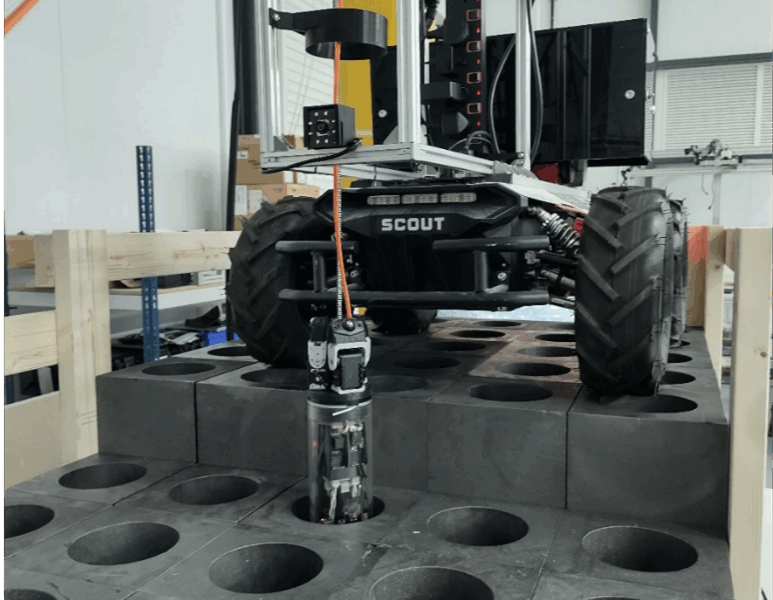
This project presents the work undertaken during Jarred Minard’s PhD, enabled through collaboration with Hot Robotics and the National Nuclear User Facility (NNUF). These partnerships created the opportunity to deploy Jarred’s developed system on a robotic platform provided by the University of Manchester’s Hot Robotics facility. A non-active demonstration of the system was performed on a graphite core mock-up constructed at the National Composites Centre (NCC) in Bristol.
Hot Robotics and NNUF’s User Access Scheme Fund played a critical enabling role in this PhD project. Access to specialised equipment, construction of mock-ups, and rental of cell space in advanced research facilities are often beyond the budget and scope of a single PhD, yet are crucial for progressing towards active deployment – Hot Robotics helped make this possible.
Jarred’s PhD focused on the development of robotic systems to deploy Raman spectroscopy inside the fuel channels of graphite-moderated nuclear reactors. Characterising these reactor graphite cores is traditionally expensive and relies on a process called trepanning, where a trained team retrieves small cored samples from fuel channels using specialised equipment. These samples are radioactive and therefore require stringent storage, handling, and transport protocols—often leading to analysis times of up to two years from the trepan date.
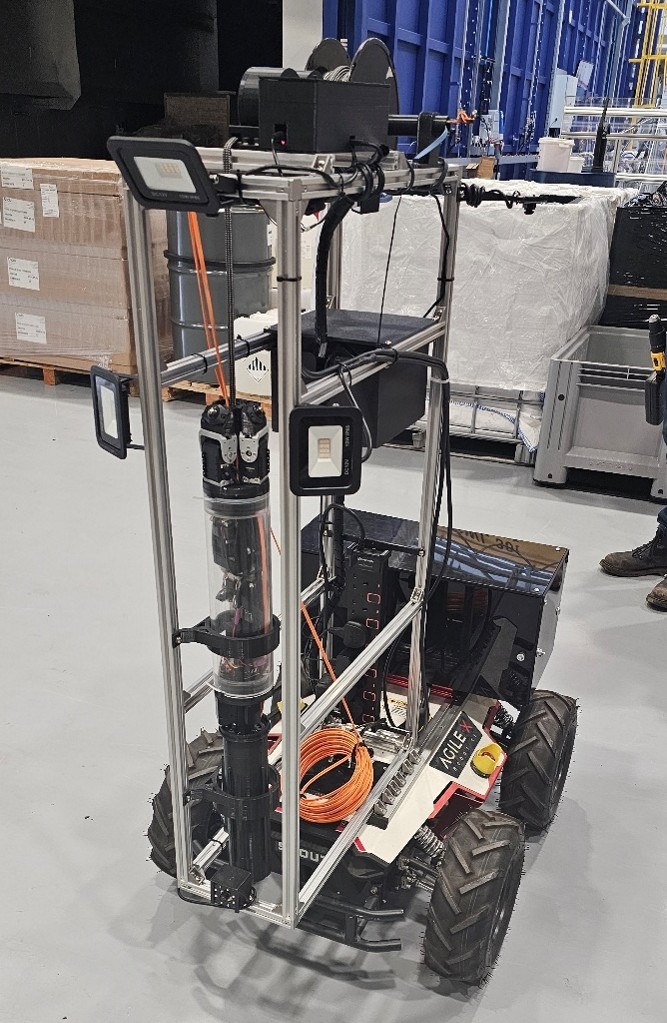
In response, Jarred developed a novel robotic probe capable of being deployed from the pile cap, lowering through standpipes, and then focusing a Raman probe (developed by Clifton Photonics) inside a fuel channel. This enabled real-time, in-situ analysis of fuel channel surface chemistry and material condition, eliminating the need for sample extraction.
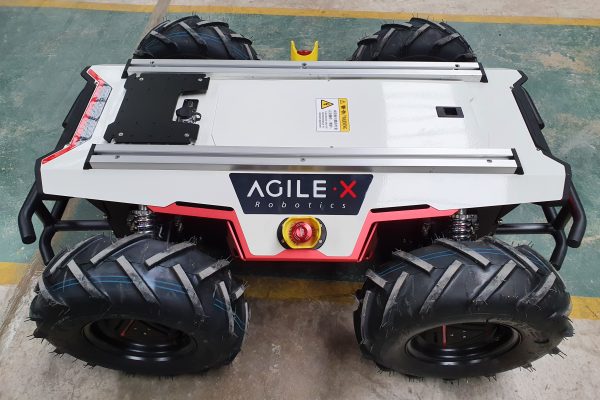
The robotic system was validated using active samples in a laboratory setting as well as with a non-active graphite mock-up. The University of Manchester’s Hot Robotics facility (RAICo1) provided the robotic platform—an AgileX Scout 2.0—onto which the system was mounted and integrated via a mesh network and custom software.
A non-active demonstration was subsequently performed for Nuclear Restoration Services (NRS), helping improve system reliability—an essential element of the safety case required for active-site deployment. Following this, NRS provided the opportunity to deploy the system within a live reactor environment.
This deployment took place on 28 January 2025, when the system was successfully operated inside Trawsfynydd Reactor 1. It obtained several Raman spectra directly from the fuel channel surface, marking the world’s first use of robotics for in-situ Raman spectroscopy of irradiated graphite.
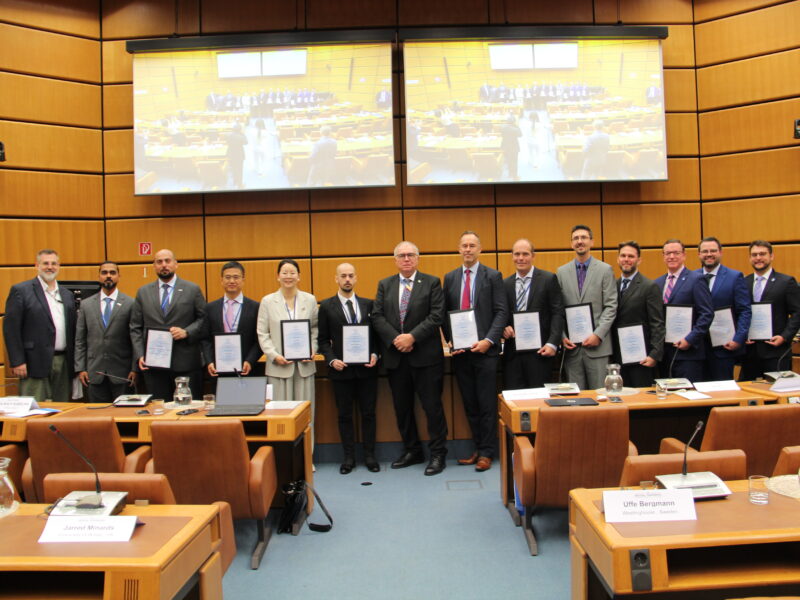
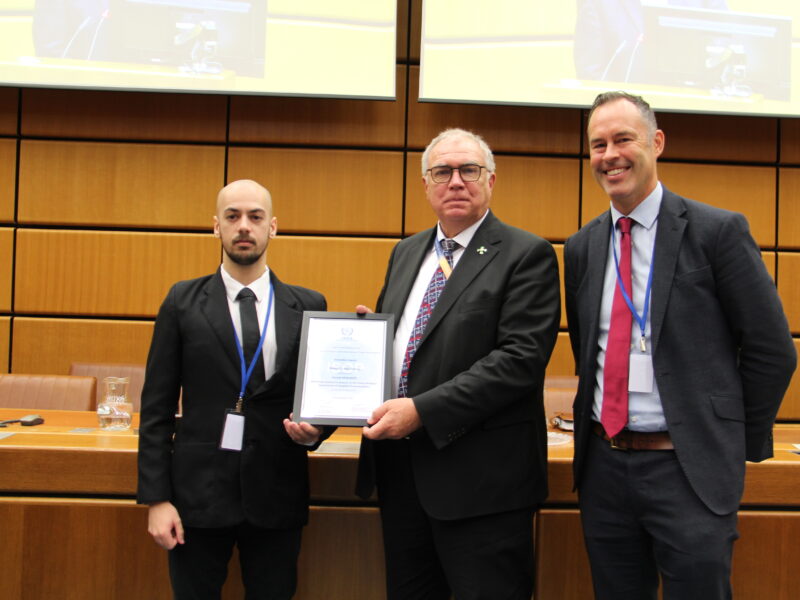
This work earned the International Atomic Energy Agency (IAEA) ISOP 2025 Award for Innovation in Robotics, recognising the novel achievement of deploying stand-off Raman spectroscopy inside a graphite fuel channel within an operational nuclear reactor.
Jarred’s PhD exemplifies the value of strong collaboration between industry and academia. Nuclear Restoration Services and the University of Bristol worked together to enable innovation: the University provided cutting-edge research, while NRS supported the project through site access, virgin graphite material for mock-up construction, and the opportunity for active deployment.
Hot Robotics and the NNUF User Access Scheme Award were key enablers, providing access to facilities, equipment, and funding that would otherwise be beyond the reach of a PhD project. By supporting students, researchers, and universities, the Hot Robotics facility enables world-class research and demonstrates how advanced robotic platforms can be applied to challenging environments.
Acknowledgments
National Nuclear User Facility (NNUF) Management Group – For awarding funding through the User Access Scheme Fund.
Phoebe Lynch (Nuclear Restoration Services) – For acting as Jarred’s industrial supervisor.
Richard Harris (Nuclear Restoration Services) – For championing and driving the opportunity for active deployment.
The NRS Trawsfynydd Team – For providing the deployment opportunity and managing the safety case required for novel deployments.
Dr Chris Hutson – For project management and coordination of the graphite mock-up construction.
Clifton Photonics — Dr John Day and Dr David Megson-Smith – For loaning the spectrometer and developing the stand-off Raman probe.
Professor Tom Scott – For project management support and funding of the PhD.
Catalin Stefan Teodorescu, Pawel Ladosz, Amy Johnson, Tom Bennett, and Sofia Leadbetter – For technical and logistical support from the Hot Robotics team.